
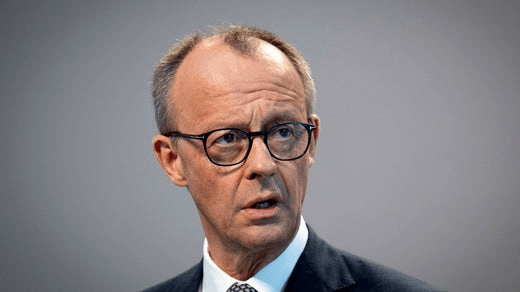
From the first day of the new government – probably May 7 – Germany will introduce border controls against its neighboring countries. This was at least promised by Friedrich Merz during the election campaign. He is almost certainly Germany’s next chancellor, as his party, the Christian Democrats (CDU), has signed a coalition agreement with the Social Democrats (SPD).
The spontaneous and temperamental Merz is known for sometimes shooting from the hip. But when it comes to immigration, he has long been consistent: it should be reduced at all costs. Germany will stop accepting asylum applications at the border. Merz refers to German security. Germany’s neighbors do not buy this. Germany is located in the heart of Europe, and eight neighboring countries are affected: Poland, the Czech Republic, Austria, Switzerland, France, Luxembourg, Belgium, and the Netherlands. All are members of the Schengen Area, where border controls are prohibited except in exceptional cases.
The German coalition agreement states that the controls will take place “in cooperation” with neighboring countries. Luxembourg is not convinced.
A violation of EU law, says Luxembourg’s Interior Minister Léon Gloden to Euractiv.
Merz, for his part, insists that the Schengen Agreement does allow for temporary border controls. The problem is that the border controls the new German government plans do not seem temporary at all. Germany already introduced border controls last year. The result is that 225,000 commuters between Luxembourg and Germany are stuck in traffic jams every day. The main reason is that these are stationary border controls, not random checks.
Germany simply does not have enough border guards for the process to run smoothly. Therefore, the neighboring countries are not at all pleased with the outlook. At the same time, the new German government plans massive deportations of the over 226,000 people whose asylum applications have been rejected but who have not left the country. Merz’s government also intends to significantly worsen the conditions for Ukrainian refugees. Those who arrived after April 1 will no longer automatically become part of the German social system, but will have to declare their wealth. People waiting to be deported to countries like Afghanistan and Syria will no longer be eligible for legal aid.
Germany’s previously generous refugee policy has been part of a strategy. It has wanted to be explicitly humanitarian to strengthen its international standing.
That strategy no longer applies. Or at least, it is being applied more and more selectively.

Leave a comment