
After eight seasons of Mad Men, Jon Hamm will forever be associated with the role of Don Draper—one of TV history’s most iconic characters. A cunning yet charismatic ad man who sold dreams while being tormented by inner demons.
Now, Jon Hamm is back in the spotlight with a new major series revolving around yet another complex and privileged white man from New York—in free fall. In Your Friends & Neighbors, he plays Andrew “Coop” Cooper, a hedge fund manager who is forced to reinvent himself as a gentleman thief after losing both his job and marriage. To maintain his social image and pay the bills, he begins stealing from his ultra-wealthy neighbors in an exclusive suburban idyll.

“The series is partly about how absurd wealth comes at a high price, and the consequences of crossing moral lines just to maintain a social facade. We ask very relevant questions—how much wealth is enough? And is more money always better?” says Jon Hamm, dressed in comfortable everyday clothes, red-tinted glasses, and holding a coffee mug in a Manhattan hotel room—the same Manhattan that was once Don Draper’s playground.
“If Don Draper was responsible for selling the American Dream, then Andrew Cooper is responsible for buying it,” Hamm explains.
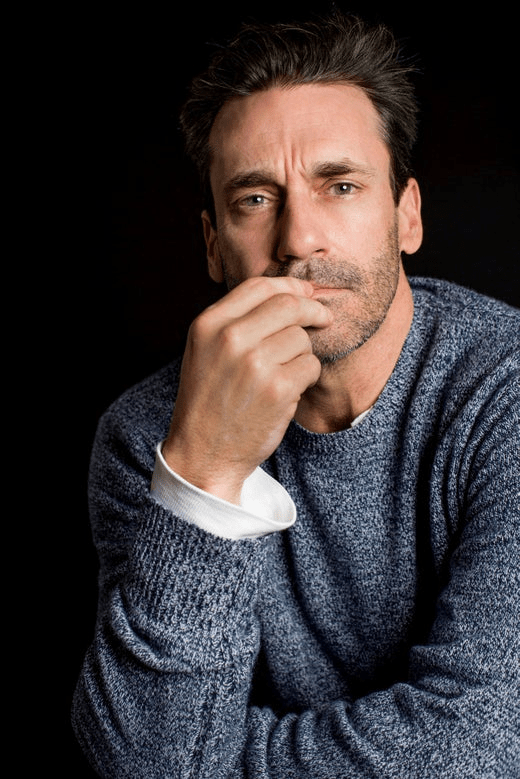
“These days, it’s not just we Americans being spoon-fed materialistic ideals—it’s a cultural concept that has spread globally, not least through social media. Even at a very young age, you can look at a screen and feel like you have to catch up with others,” says Hamm, who has never used social media himself.
“We’re in the middle of a wake-up call—social media is being abused, and it’s more about commercialization than actual socializing now. But we’ll pay a heavy price for turning small children into consumers—it’ll have serious consequences.”

Your Friends & Neighbors is written by Jonathan Tropper, known for previous series like Banshee and Warrior. In the 2000s, he wrote novels such as This Is Where I Leave You, The Book of Joe, and How to Talk to a Widower.
“This series definitely shares more DNA with my novels than my earlier TV work,” says Jonathan Tropper when he appears on screen.
“When I wrote those books in my 30s and 40s, they were often about the emptiness and boredom of suburban life. Then I moved into the world of high-budget action series. But at 55, I took the opportunity to return to my roots as a novelist—this time with a more mature perspective. Sometimes more cynical, sometimes more hopeful.”

The new series is largely inspired by his observations and personal experiences growing up in affluent Westchester County, just north of New York.
“The emotional truth of the series is definitely influenced by the years I spent in that environment and lifestyle. As for the plot itself, very little of it comes from real life. The sad truth is, most of us don’t live particularly interesting lives,” Tropper smiles, now living in the picturesque Hudson Valley.
“When I pitched the series, I referenced films like American Beauty and The Ice Storm. I also made it clear I wasn’t trying to create a new Breaking Bad—this is more in line with The White Lotus. I’m more inspired by other authors than TV shows, and I naturally wanted to create something of my own.”
Just like in series such as The White Lotus and Succession, Tropper explores the emotional voids of the super-rich—the emptiness that arises when material wealth and social status are confronted with internal loneliness and vulnerability.
“On the surface, it might seem like the series is about holding on to what you have—but really, it’s more about realizing that what we thought was permanent might not be. And how little control we truly have over our lives. The pandemic showed us how fragile everything is and forced many of us to reevaluate our lives,” Tropper says, adding a disclaimer:
“I don’t make TV to preach—I aim to shed light on things. Hopefully, the series sparks conversations about wealth, waste, status, and inequality—both in the U.S. and globally. What do we actually need to live a meaningful life?”
What was the biggest challenge during filming?
“Convincing people with really nice houses to let us film in them, haha. The kinds of homes we wanted are owned by people who don’t need the money. So we had to find homeowners willing to suffer for the art—or just plain curious,” Tropper grins.

In the series’ very first scene, Jon Hamm’s “Coop” wakes up in a pool of blood next to a dead man in a lavish neighbor’s house. His own voice-over narrates that he’s about to recount “the swirling chaos” of his life that began four months earlier. This sets the stage for a descent into a dark maelstrom of secrets, lies, drugs, and toxic masculinity.
One scene notes that the rich men around him are drawn to “whiskey and cigars, custom golf clubs, and luxury escorts—entire industries built on monetizing the silent desperation of wealthy middle-aged men.”
“The voice-over gave me the chance to write more like I did as a novelist and gave the series a literary feel. At the same time, I wanted a voice that could convey both humor and irony—with hindsight. I’ve always loved noir films and their use of voice-over—not always driving the plot but adding a deeper layer,” Tropper explains.
As soon as he came up with the idea for the series, he had Jon Hamm in mind. Once Hamm was fully on board, the two sold the idea to Apple TV+, which has already greenlit a second season.
“I couldn’t imagine anyone else in the role—even though we knew everyone would compare him to Don Draper the moment we put him in a sharp suit with a glass of whiskey. But Jon is nearly ten years older since Mad Men ended, so our series quickly deconstructs that old image. Andrew Cooper is a much hotter mess than Don Draper ever was. The fun lies in tearing apart the Don Draper mythology and meeting a more vulnerable, more human character,” says Jonathan Tropper.
As a showrunner, he was careful to give Hamm’s new character the right traits that reflect who he is. It’s no coincidence that Coop plays tennis in designer gear, sips 25-year-old Macallan Scotch, and drives a Maserati.
“I thought, Cooper is the kind of guy who could buy a Ferrari—but thinks it’s a bit of a cliché. He wants something that stands out but still shows his wealth. The Maserati isn’t the most expensive or the fastest, but it signals exclusivity and personality. Even if he’s just trying to be unique in a way that still follows the norm,” Tropper says.
In the show, Coop steals from his neighbors, who own mansions “full of expensive crap no one would ever miss, piles of forgotten wealth just sitting in boxes,” as he puts it while snatching up ultra-luxury watches from Patek Philippe and Hermès Birkin bags.

“Part of the drive and humor in the show is that Cooper isn’t particularly good at stealing,” Jon Hamm laughs. “He kind of has to learn on the go. The idea was never that he’d be some superhuman Bruce Wayne figure—more of a klutz, though good enough to avoid getting caught.”
Jon Hamm didn’t use any specific method to prepare for the role.
“Well, I definitely didn’t hang out with thieves—at least not intentionally. But who knows? Maybe we’re all hanging out with thieves without realizing it? What I have always practiced, though, is being a good neighbor. I think it’s really important to get to know your neighbors—which isn’t the same as always liking them,” says Hamm, who mostly lives in Los Angeles with his wife Anna Osceola, who has a supporting role in the series.
But inviting neighbors over to watch TV shows together? That’s a bit much, he chuckles.
“Sometimes we’ll have a few friends over and watch something like The White Lotus or the like. But most of the time, it’s just my wife, me, and our dog. Cooking dinner and then watching a show or movie together on the couch—that’s our thing. A perfect evening,” says Jon Hamm with a smile.
“Maybe Your Friends & Neighbors will be our next thing to watch together, now that we’re both in it…”

Leave a comment