
STOCKHOLM/BRUSSELS – President Donald Trump’s various statements have shocked Sweden and Europe. So far, the Swedish government has taken a cautious public stance.
“But of course, trust is being shaken,” says Foreign Minister Maria Malmer Stenergard (Moderate Party).
DN accompanied her to Brussels for the NATO meeting.
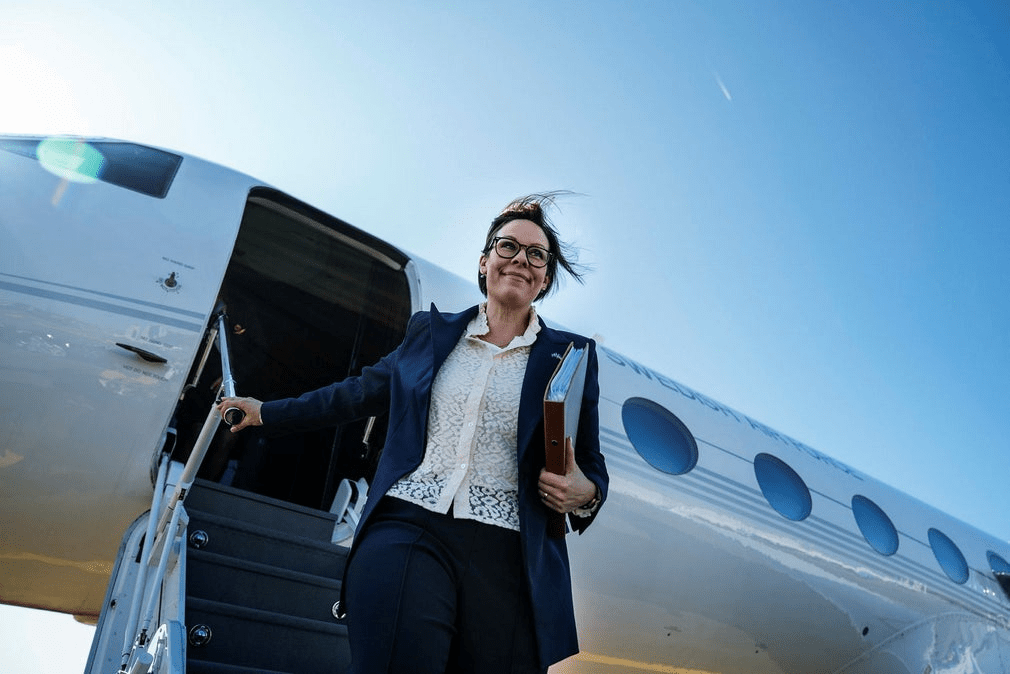
“It’s a good morning,” says Maria Malmer Stenergard as she steps into the VIP terminal at Arlanda Airport for her departure to Brussels.
A somewhat unexpected comment, considering that President Trump announced new tariffs the night before, causing stock markets to fall globally. But it isn’t Trump the minister is focused on this morning—it’s another piece of news: Colombia is set to purchase the Swedish fighter jet, Jas Gripen. Her visit to Colombia last winter, together with a delegation of Swedish companies, has paid off.
On the government plane, they are served Danish-style open-faced sandwiches—salmon and air-dried ham with brie and fresh figs. The foreign minister has received a thick binder from her staff and is reading classified documents in preparation for the meeting with NATO foreign ministers—a meeting where many eyes are on what message the alliance’s most important member, the U.S., will bring in the form of Secretary of State Marco Rubio.
Statements from American representatives are unsettling Europe. That a member of the defense alliance would openly declare its desire to annex another member’s territory (Greenland) is unprecedented. The reactions from Denmark have been strong. Danish Foreign Minister Lars Løkke Rasmussen has called the U.S. action an “attack on Denmark’s sovereignty.”
There’s a police escort to NATO headquarters.
Photo: Sara Damne
From Maria Malmer Stenergard and other Swedish ministers, the statements have stopped at Sweden standing behind Denmark. It’s a continuation of the government’s mantra to keep a cool head and see what the Trump administration actually does, rather than reacting to everything it says.
“By keeping a cool head, I mean staying calm and preparing for a range of different scenarios. Regarding Greenland, we maintain very close contact—almost daily—with our colleagues in Denmark to understand what kind of support they want and act accordingly.”
Is it Denmark that wants Sweden to keep a low profile, or is it self-imposed?
“I wouldn’t say we’re keeping a low profile. We support Denmark at every stage, and of course, we listen to what kind of support they want and act based on that.”

Maria Malmer Stenergard’s party colleague, Gunnar Hökmark—former MP, EU parliamentarian, and party secretary—has a different attitude. In an op-ed in Svenska Dagbladet, he proposed establishing a Nordic force on the island, in agreement with Greenland’s government, to defend international law.
“Greenland is part of NATO. The current development is to strengthen the military presence there, and that is what Denmark is doing,” comments Maria Malmer Stenergard.
Would Sweden contribute troops if Denmark requested it?
“We would have to assess that if and when the time comes.”
When it comes to Europe’s relationship with the U.S., Maria Malmer Stenergard avoids saying anything that could further split the continents. She hopes the relationship can improve.
“But of course, trust is being shaken. I want to return to a place of mutual trust.”
Maria Malmer Stenergard has been foreign minister for six months, after Tobias Billström suddenly and unexpectedly stepped down. At that time, Joe Biden was president of the U.S. Few believed there would be a trade war, that Ukraine’s President Zelensky would be humiliated in the White House, or that the U.S. would vote alongside Russia and North Korea on a UN resolution regarding Ukraine.

She still believes in the unity of the Western world.
“But it has become clear in recent months that there is a strong common interest in Europe, and especially in the Nordic region.”
Maria Malmer Stenergard remains professional and neutral—as always. Given the state of the world, is there anything she reacts to strongly?
“As a human being, I certainly feel and think a lot of things, but my task is to act in line with what is best for Sweden. And I rarely think that reacting emotionally is the best course.”
When was the last time you felt upset?
“I wouldn’t say I got upset during my visit to Israel and Palestine, but I must say I was deeply affected by how deeply entrenched and hostile the situation is. It’s so frozen that all you feel is great sorrow.”
Her trip to the Middle East was heavily criticized, partly because it coincided with Israel launching a new offensive in Gaza.
“It is more important than ever to go there. It’s a very difficult conflict, and I naturally met with representatives from both Israel and Palestine. By maintaining a relationship with Israel, we can also voice criticism—and I did—particularly concerning humanitarian aid to Gaza, stopping settlements, and returning to the negotiating table.”
During her trip, Maria Malmer Stenergard also visited the West Bank.
What are your impressions from there?
“I see aggressive behavior from Israel where they are appropriating new land and expanding. That violates international law, and we are clear about that.”
What can Sweden do to support the Palestinian Authority?
“We’re doing quite a lot. Among EU countries, we have the highest number of secondments to Palestine.”
Secondments mean that Sweden lends experts from various government agencies to help Palestine build a functioning state, including police, prosecutors, and other institutions.
During her two days in Brussels, she also meets six exiled journalists from Russia and Belarus, who ask about Sweden’s current relations with those countries. The answer: virtually none.
“Keep fighting,” Stenergard encourages the journalists at the end of the press conference.
“You too,” some of them reply.
Is it hard to be foreign minister?
“It’s extremely hard. It’s difficult to accept that you have to prioritize because there’s so much you want to do, but don’t have time for. When things calm down somewhere in the world, something new emerges. It’s also frustrating that you can’t always talk about everything you’re doing, like in consular cases.”
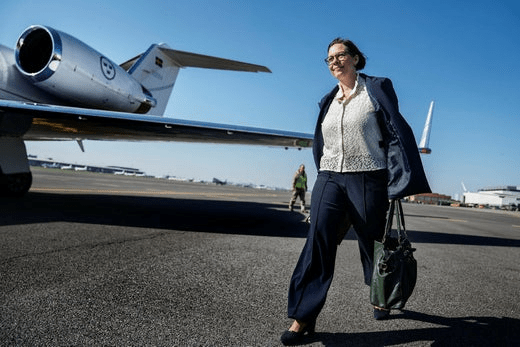
On the flip side, she sees it as a huge privilege to work in an area that is at the heart of politics.
After the NATO meeting, Maria Malmer Stenergard speaks with Swedish journalists on site. She has had a brief conversation with U.S. Secretary of State Marco Rubio and notes that the message is that the U.S. wants to be part of the defense alliance and sees it as incredibly important.
Rubio unexpectedly cancels his planned press conference. Instead, he meets with a select group of mainly American journalists and claims that Greenlanders don’t want to be part of Denmark.
By then, Maria Malmer Stenergard is already in a police escort on the way to Brussels Airport for her flight home on the government plane.

Leave a comment