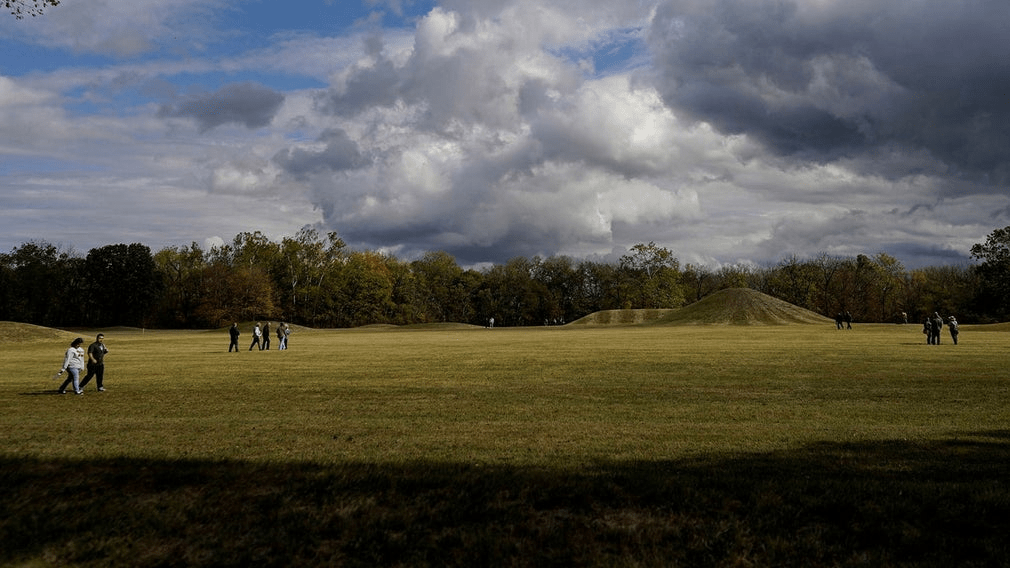
“There used to be a sauna or some kind of purification site here,” says Chief Archaeologist Brad Lepper to the BBC, pointing to a circle in the grass.
The earth mounds in the “Octagon,” as the site is called, are part of the “Hopewell Ceremonial Earthworks” – a network of hand-built earth mounds scattered across central and southern Ohio, built nearly 2,000 years ago. These sites were used as communal gathering places, and indigenous peoples traveled there from near and far to participate in rituals and ceremonies. At times, people traveled hundreds of kilometers to take part in these rituals. In the middle of the perfectly manicured grass circle at the Octagon stands a golf flag – the site was a golf course from 1920 to 2024. But now, for the first time in 100 years, it will open to tourists rather than golfers.
The ceremonial earthworks were built by the Hopewell culture, a group of Native American peoples that stretched from Montana in the northern U.S. to the Gulf of Mexico in the south. They lived around 100 BC to around 500 AD.

Brad Lepper says that the Octagon was once part of a larger Hopewell complex that spanned 11.5 square kilometers, connected by roads with earthen walls.
“You could fit four Colosseums just inside the Octagon,” says Lepper, continuing: “Stonehenge would fit in the small circle that has now been a putting green.”
He adds that the indigenous people constructed the site without modern tools. They dug up earth with sharpened sticks and carried an estimated 200,000 cubic meters of earth in baskets on their backs.
The moon is believed to have been important to the Hopewell culture, and ritual sites were built according to the moon’s cycle. Every 18.6 years, the moon rises exactly over the center of the Octagon.

Since the Hopewell culture left no written records, the earth constructions and a few found objects are the only evidence of their existence. Among the finds are ritual pipes and a small stone statue of a shaman wearing a bear skin and holding a human skull.
When the Hopewell culture gradually disappeared around 500 AD, other indigenous peoples took over the site. One of these groups was the Shawnee, who lived in Ohio until they were forcibly relocated west of the Mississippi River in the 1830s.
“We may not have been the ones who built or created them, but I know that my ancestors lived here, and that my ancestors protected them and showed them respect,” says Chief Glenna Wallace, who now hopes people will visit the site and learn about the cultural phenomenon.


Leave a comment