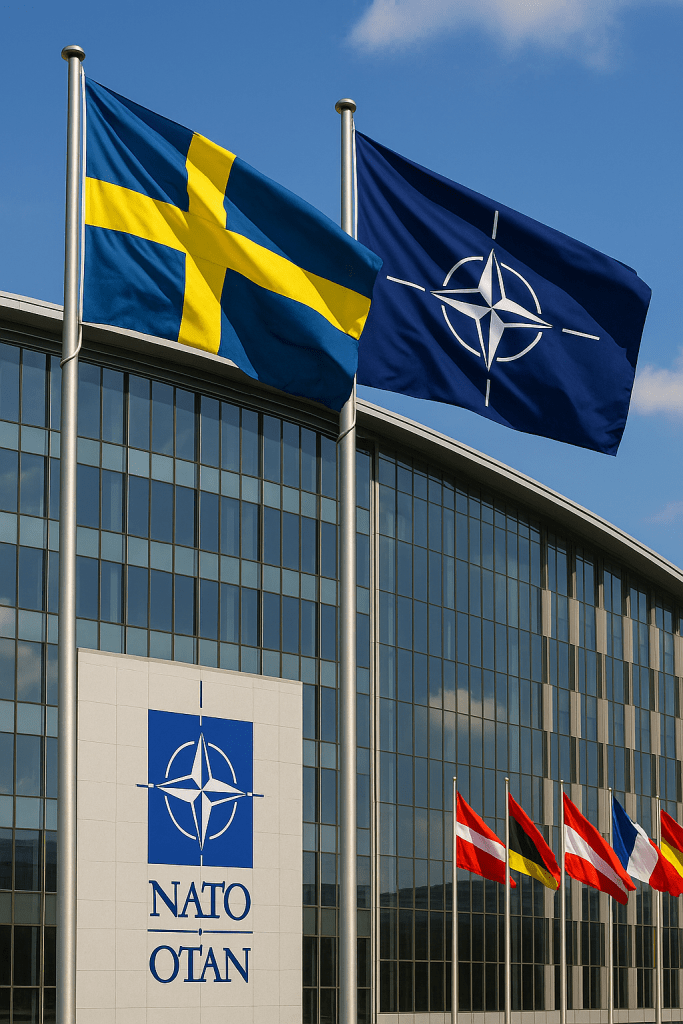
In a historic shift away from two centuries of military non-alignment, Sweden has officially become the 32nd member of the North Atlantic Treaty Organization (NATO). The country’s accession, finalized in Brussels on July 15, 2025, marks a significant transformation in Sweden’s defense and foreign policy, prompted by growing geopolitical instability and security concerns in the wake of Russia’s 2022 invasion of Ukraine.
A Century of Neutrality Ends
Sweden has long prided itself on neutrality, maintaining an independent defense policy since the early 19th century. Even during the Cold War, when neighboring countries like Norway and Denmark joined NATO, Sweden chose to remain outside the alliance, emphasizing diplomatic solutions and regional peacekeeping.
However, the changing security environment in Europe — particularly the escalation of Russian aggression — has profoundly impacted public opinion and political consensus. A 2024 poll by the SOM Institute at the University of Gothenburg revealed that 67% of Swedes supported NATO membership, a drastic increase from just 32% in 2021.
“Sweden’s NATO membership is not a decision made lightly,” said Prime Minister Ulf Kristersson during a televised address. “It is a decision made in the interest of our national security and the stability of Northern Europe. We join the Alliance as equals, and as defenders of freedom, democracy, and peace.”
Long Road to Accession
Sweden’s NATO application, submitted alongside Finland in May 2022, faced initial resistance from Turkey and Hungary. Both countries raised objections over Sweden’s stance on Kurdish groups and other political issues. It wasn’t until early 2025, after months of diplomatic negotiations and reforms, that both parliaments ratified Sweden’s membership.
Finland, in contrast, became a member in April 2023. The staggered accession raised strategic questions about Nordic security, particularly given the two countries’ shared defense agreements and geographic proximity to Russia.
With Sweden’s accession, NATO now controls the entirety of the Baltic Sea coastline, excluding the Russian enclave of Kaliningrad. This development significantly enhances NATO’s strategic position in northern Europe, especially regarding deterrence and rapid deployment capabilities.
Security Commitments and Military Upgrades
As a full NATO member, Sweden is expected to contribute to collective defense efforts, including participation in joint military exercises and fulfilling the alliance’s 2% GDP defense spending guideline. In recent years, Sweden has already begun investing heavily in its armed forces, increasing its defense budget by 40% between 2022 and 2025.
The Swedish Armed Forces have also expanded their cooperation with NATO through joint operations and intelligence sharing. Sweden has hosted several NATO military exercises, including the recent Aurora 25, which involved over 20,000 troops from 14 countries.
“We are committed to defending not only our homeland but also our allies,” said Swedish Defense Minister Pål Jonson. “Our defense strategy now includes NATO’s collective security umbrella, which greatly enhances our deterrent posture.”
Public Reaction and Regional Impact
The response to Sweden’s NATO membership has been largely positive domestically. Many citizens feel reassured by the collective defense guarantees provided under Article 5 of the NATO treaty, which states that an attack on one member is an attack on all.
However, not everyone supports the move. Left-leaning parties and pacifist groups have criticized the decision, arguing that it risks escalating tensions with Russia and undermines Sweden’s role as a neutral mediator in global conflicts.
Russia, for its part, condemned the decision. The Kremlin released a statement warning of “serious consequences” and announced plans to strengthen its military presence in the northwest region near the Finnish and Swedish borders.
Looking Ahead
Sweden’s NATO membership represents not only a response to immediate security threats but also a broader reorientation of its international role. It signifies a new era of collective defense and solidarity among Western democracies facing renewed global challenges.
As Sweden raises its flag at NATO headquarters in Brussels, the moment is both symbolic and strategic. It signals the end of an era of neutrality and the beginning of a deeper integration into Europe’s defense architecture.
“We stand together, united by shared values and a commitment to peace,” said NATO Secretary-General Jens Stoltenberg. “Sweden’s membership makes our alliance stronger, our people safer, and our future more secure.”

Leave a comment