Sweden is navigating a critical juncture in its national security and fiscal policy, as the country shifts from decades of relative military modesty into a new era of defence readiness and budgetary re-adjustment. Two recent developments illustrate both the urgency and the challenge that lie ahead: the delivery of the first Saab Gripen E combat aircraft to the Swedish Air Force, and a public warning from the Sveriges Riksbank (Swedish central bank) governor stressing the need for a return to fiscal discipline.
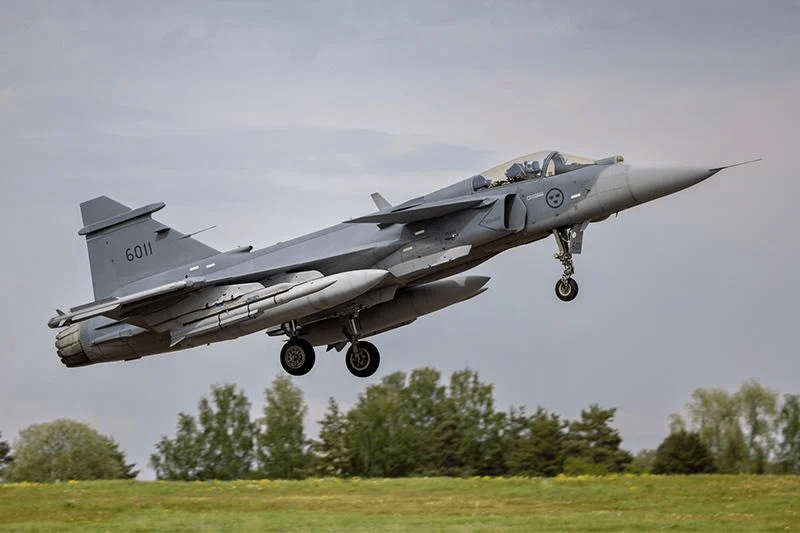
On 20 October 2025, Sweden received its first Gripen E fighters, signalling a tangible step in its long-term plan to modernise its air force and strengthen deterrence in the Baltic region. The move comes amid rising tensions with Russia, increasing deployments of NATO forces around Sweden’s maritime approaches, and a broader willingness in Stockholm to align more closely with collective defence frameworks.The delivery of the Gripen E is thus not merely a hardware upgrade—it forms part of a symbolic and strategic shift: Sweden is re-positioning itself from “armed but moderate” towards “armed and ready”.
At the same time, the Swedish central bank governor, Erik Thedeen, recently delivered a pointed speech warning that while the defence build-up is necessary, the accompanying surge in public borrowing cannot become a perennial burden. Sweden temporarily suspended some of its traditional fiscal rules to permit roughly 300 billion kronor in extra borrowing—funds directed chiefly at defence and support for Ukraine following Sweden’s accession to NATO.Thedeen noted that while the situation is not yet crisis-level, the lack of a clear path back to balanced budgets is concerning, especially given commitments such as spending 3.5 % of GDP on defence and 1.5 % on civil defence as a permanent re-orientation.
The dual challenge is clear: Sweden must build credible deterrence and bolster security at a time when its economy and budgetary frameworks were not structured for sustained high-military spending. On one hand, the defence modernisation (e.g., Gripen E, possible future unmanned systems, deeper NATO integration) demands long-term financing and strategic clarity. On the other hand, returning to fiscal discipline is required to preserve Sweden’s reputation for prudence, maintain investor confidence, and keep social spending sustainable.

This tension is being played out in domestic politics as well. The government must balance public expectations of robust national defence with the Scandinavian welfare-state tradition of generous services and low deficits. If voters believe that defence spending is eating into schools, healthcare or pension commitments, political backlash could ensue. Conversely, security hawks warn that delaying modernisation or scaling back ambitions risks leaving Sweden vulnerable in an increasingly volatile neighbourhood.
Another dimension is Sweden’s operational posture. With the Gripen E delivery, Sweden sends a message: it intends to remain a military actor, not just a passive observer. This has implications for Sweden’s role in European defence, its contributions to NATO operations, and its relationship with neighbouring countries such as Finland, Norway, and the Baltic states. The strategic calculus now includes maritime, air and cyber domains, with Sweden moving away from its traditional posture of neutrality (prior to NATO accession) to one of cooperative defence.
However, the budgetary side cannot be ignored. Theedeen’s warning underscores that defence spending cannot remain exceptional—it must fit within a sustainable fiscal framework. Over time, Swedish taxpayers will expect transparency: where is the extra spending going, how will efficiency be measured, and how will the country avoid the fate of heavy-spending but underperforming States?
Looking ahead, Sweden will face a series of key decisions: approving the next tranche of defence procurement, negotiating budgetary offsets (e.g., finding savings in non-defence areas), and refining its long-term strategy for both physical and digital threat landscapes. The country will also need to communicate clearly to its citizens: national security is not just about jets and tanks; it’s about resilience, readiness, civilian-military integration, and social cohesion.
In summary, Sweden stands at a strategic inflection point. The delivery of the Gripen E signals the new era of readiness; the central bank’s warning signals the constraints within which that readiness must be financed. The outcome will depend not only on defence policy, but on fiscal discipline, political consensus, and the ability to adapt Sweden’s welfare-state model to a changed security environment. If Sweden succeeds, it could become a model for small-to-mid-sized states adapting to intensifying geopolitical competition. If it stumbles, the legacy of a proud neutrality may become a cautionary tale of under-preparedness or fiscal overreach.

Leave a comment