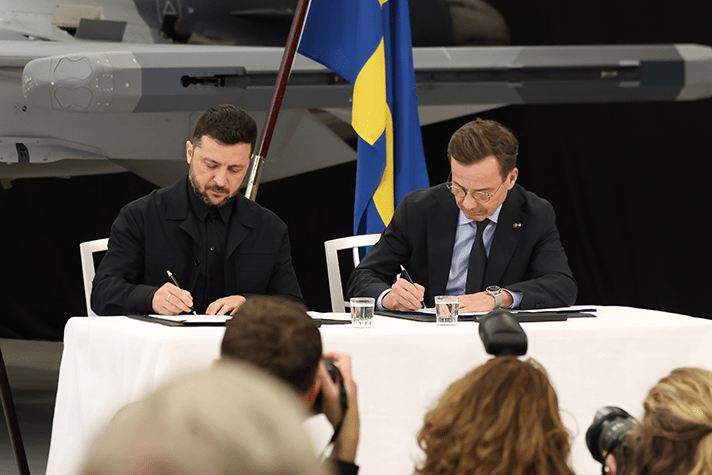
On 22 October 2025, a significant milestone in Scandinavian defence policy was reached when Swedish Prime Minister Ulf Kristersson welcomed Ukrainian President Volodymyr Zelenskiy to Stockholm for formal talks and a much-anticipated defence cooperation announcement.
A landmark agreement
In a joint press briefing held in the southern Swedish city of Linköping, the two leaders signed a letter of intent that could see Sweden supply up to 150 of its domestically-produced JAS 39 Gripen E fighter jets to Ukraine.
The Swedish defence manufacturer Saab AB, located in Linköping, produces the Gripen model, making this potentially the largest export order in Sweden’s aviation history.
Prime Minister Kristersson described the agreement as “a long road ahead” but emphasised Sweden’s commitment to helping Ukraine strengthen its air defence capability. The partnership also covers broader air-defence cooperation beyond the aircraft-supply deal.
Strategic and geopolitical implications
For Sweden, this move marks a shift from a traditionally moderate defence-export posture toward a more assertive international role. Supplying advanced fighter jets to a nation at war is a bold statement of strategic alignment. The deal reinforces Sweden’s ties with Ukraine and its Western partners, signalling that Swedish industry and government are willing to play a direct role in the European security architecture.
From Ukraine’s perspective, acquiring the Gripen fleet would represent a substantial boost to its air force’s capabilities and a step toward re-equipping for long-term defence and deterrence. The possibility of 100 to 150 units gives Kyiv a sizeable ordering horizon.
Both countries emphasised that additional support services — maintenance, training, system integration — will accompany the hardware, turning the deal into a multi-year cooperative venture.
Industrial & domestic considerations
For Saab and the Swedish defence sector, this contract could significantly raise export revenues and employment in high-tech manufacturing. It also puts pressure on domestic production capacity, supply-chains, and political oversight given the sensitivity of exporting advanced weapons.
Domestically, Sweden faces the challenge of balancing public opinion on weapon exports, potential escalation risks, and implications for Swedish neutrality traditions (though Sweden today is a NATO member). The government will need to ensure parliamentary and regulatory frameworks align with such a large-scale export.
Longer-term context
This agreement comes amidst a broader transformation of Swedish defence policy. Sweden intends to raise military spending and strengthen its armed forces following shifts in Europe’s strategic environment. While the deal with Ukraine is headline-making, it sits within a larger trend of Sweden deepening defence ties and exports.
What to watch
- The detailed contract: cost, delivery schedule, training & support commitments.
- Parliamentary and regulatory approval in Sweden for exports to an active conflict zone.
- Impact on Saab’s production timelines and Swedish industrial policy.
- Ukraine’s ability to integrate and operationalise the Gripen fleet amid ongoing war.
- Reactions from regional actors, including Russia, and from NATO partners.
In summary, the Sweden-Ukraine Gripen deal signals a new chapter for Swedish defence diplomacy and industry. It brings tactical impact for Ukraine, strategic weight for Sweden, and raises questions about how European arms-exports will evolve in a changed security environment.

Leave a comment