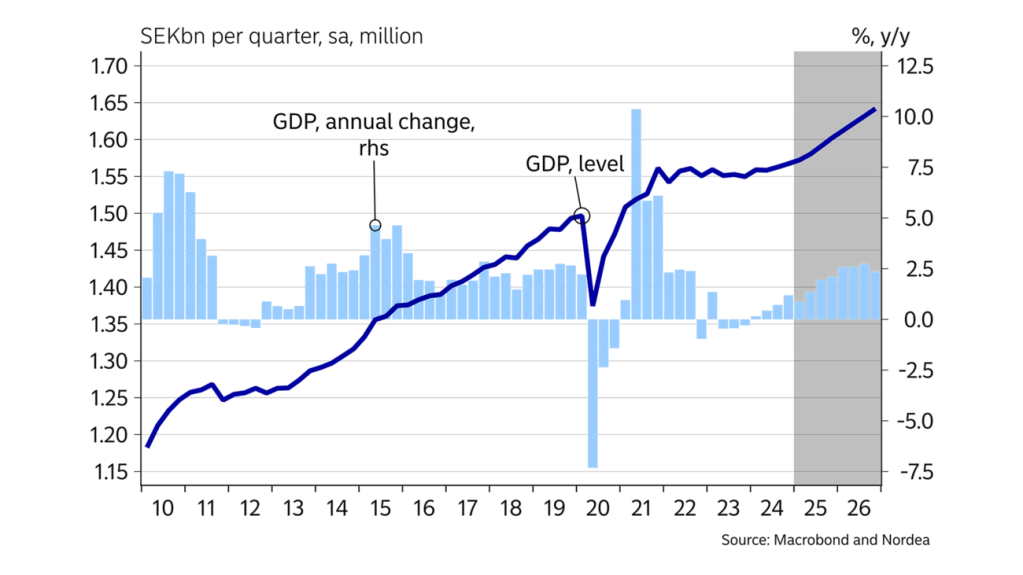
Stockholm, Sweden — Sweden’s economic outlook is showing increasingly hopeful signs in 2025, according to a recent evaluation by the International Monetary Fund (IMF). The IMF concluded its Article IV Consultation with Sweden, forecasting a real GDP growth of 1.9% in 2025 and 2.2% in 2026, supported by favorable macroeconomic policies and improving productivity.
Inflation Under Control
The report noted that inflation — a major concern during turbulent times — has been successfully re-anchored around 2%, close to the Riksbank’s target.
According to IMF analysts, this stability allows Sweden to maintain supportive fiscal and monetary policies, without risking runaway price increases.
Policy Support and Resilience
IMF economists praised Sweden’s policy mix. They highlighted that the country’s recovery is underpinned by fiscal stimulus, lower interest rates, and a renewed focus on productivity-enhancing reforms.
These measures, combined with strong households and improving consumer sentiment, make Sweden relatively well-positioned despite global headwinds.
Risks Still Lingering
However, the IMF also warned of potential challenges. Sweden faces geopolitical uncertainty, partly driven by tensions in Europe and fluctuating demand from trading partners.
Exports remain fragile, and any escalation in trade conflicts could weigh on growth. Meanwhile, the labor market recovery is expected to be gradual, according to IMF projections.
OECD Survey Echoes the Message
Complementing the IMF’s positive assessment, a new OECD Economic Survey of Sweden (launching June 5, 2025) further underscores key areas for long-term reform.
The survey highlights Sweden’s need to improve skills development, expand affordable housing, and bolster resilience to climate change. These themes align with the IMF’s broader call for structural changes.
Domestic Forecasts Support Optimism
Domestically, the Swedish Ministry of Finance — in its mid-year forecast — sees conditions for a stronger recovery improving. Recent data show rising real wages, lower interest expenses for households, and continued fiscal support, all of which could fuel a rebound in consumption and investment.
Public Finances: Improving Trajectory
Despite mounting defense and infrastructure expenditures, Sweden’s public finances are tracking favorably. The National Financial Management Authority (ESV) has revised its deficit forecast downward: for 2025, it now estimates a deficit of 51 billion SEK, or about 0.8% of GDP — significantly less than previous estimates.
This reflects higher-than-expected tax revenues and a resilient economy.
What This Means for Sweden
- Policymakers may feel emboldened to continue supporting growth, as long as inflation remains under control.
- Businesses could benefit from increased demand, but will watch global trade risks closely.
- Families may feel more secure in spending, thanks to rising real income.
- Investors might view Sweden as a relatively stable and well-managed economy in uncertain times.
In short, although Sweden’s road to full recovery is not guaranteed, the IMF’s assessment offers a cautiously optimistic outlook — one that aligns with domestic forecasts and reflects a resilient Nordic economy.

Leave a comment