Tens of thousands of people marched through central London on Saturday in two separate mass demonstrations, one focused on immigration and British national identity and the other on Palestinian rights, creating a major test for police and city authorities as rival political currents converged in the capital.
The Metropolitan Police deployed about 4,000 officers across London, including reinforcements from outside the city, to manage the demonstrations and prevent direct confrontation between groups. Police said 43 arrests had been made by Saturday evening, while officials described the events overall as largely peaceful despite several flashpoints, alleged hate-related offences and injuries to officers.
The two demonstrations were not formally linked, but their timing and proximity gave the day a charged political character. One march was organised under the Unite the Kingdom banner by Stephen Yaxley-Lennon, widely known as Tommy Robinson, a far-right activist whose rallies have focused on immigration, Islam, crime, national identity and criticism of mainstream political leaders. The other was a pro-Palestinian march marking Nakba Day, commemorating the displacement of Palestinians during the 1948 Arab-Israeli war and calling for international action over Israel’s war in Gaza.
Police treated the day as a high-risk public order operation. The force had said before the marches that officers would make assertive use of their powers where necessary, with large numbers assigned to routes, gathering points, transport hubs and separation zones. The deployment also coincided with other major events in London, including the FA Cup Final at Wembley, adding further pressure to policing resources across the capital.
The anti-immigration demonstration drew crowds carrying Union flags and St George’s flags, with speeches and chants directed at the government, immigration policy and what participants described as threats to British identity. Robinson’s supporters have previously framed such rallies as campaigns for free speech, border enforcement and protection of British communities. Critics, including government figures, have described the movement as spreading anti-Muslim hostility and inflaming social divisions.
The UK government had moved before Saturday’s rally to block 11 foreign figures it described as far-right agitators from entering the country. Downing Street said the barred individuals intended to come to Britain to spread extremist views, and Prime Minister Keir Starmer warned that those promoting hatred or violence would face the full force of the law. The intervention gave the march a national political dimension even before demonstrators arrived in central London.
Starmer’s government has been under pressure on immigration from multiple directions: from opposition parties demanding tougher controls, from local communities concerned about asylum accommodation and border crossings, and from rights groups warning against rhetoric that could endanger minorities. Saturday’s demonstration placed those tensions in public view at a time when immigration remains one of the most contentious issues in British politics.
At the pro-Palestinian march, demonstrators carried Palestinian flags, banners and placards calling for a ceasefire, Palestinian statehood and an end to what they described as British complicity in Israeli actions in Gaza. The march was linked to Nakba Day, observed by Palestinians and supporters each year to mark the mass displacement of Palestinians in 1948. Organisers and speakers connected that historical memory to the current war in Gaza and to wider demands for justice, accountability and changes in UK foreign policy.
The pro-Palestinian demonstration began in west London and moved toward central areas where speakers addressed the crowd. It attracted activists, trade unionists, community groups, political campaigners and families. Some speakers criticised the government’s stance on Israel and Gaza, while others focused on racism, Islamophobia, antisemitism and the right to protest.
London has seen repeated large pro-Palestinian demonstrations since the outbreak of the Gaza war, often drawing tens or hundreds of thousands according to organisers, though police estimates have varied. Those marches have prompted disputes over policing, slogans, antisemitism, public disruption and the balance between free expression and community safety. Jewish organisations and some political leaders have voiced concern that repeated central London marches have left parts of the Jewish community feeling exposed, while protest organisers have said their events oppose Israeli government policy and are not directed at Jewish people.
Saturday’s police operation therefore had to manage not only two large crowds but also a politically sensitive environment in which immigration, racism, antisemitism, anti-Muslim hate, free speech and Middle East policy overlap. Officers sought to keep the demonstrations apart, monitor potential disorder and intervene where offences were suspected.
Police said arrests were made for a range of alleged offences. Reporting from the scene and police updates indicated that suspected public order offences and racially or religiously aggravated incidents were among the issues officers were dealing with. Several officers were injured, though officials said the injuries were not life-threatening. Police also said they were monitoring dispersal after the demonstrations, a period often seen as sensitive because smaller groups can break away from main routes and clash near transport hubs, pubs or public squares.
The use of live facial recognition was reported around parts of the policing operation, including major transport locations. Police have increasingly used the technology at large events to identify individuals wanted by law enforcement or subject to conditions. Civil liberties groups have criticised live facial recognition as intrusive and insufficiently regulated, while police say it can help detect people who may pose a risk at crowded public events. Its presence on Saturday is likely to add to the broader debate over surveillance and protest rights in Britain.
Authorities also placed conditions on routes and gathering points, a standard tool under public order law when police believe restrictions are necessary to prevent serious disruption, disorder or intimidation. Such conditions can include limits on where a protest may assemble, how long it may remain in an area, and which route a march may take. In practice, the aim on Saturday was to prevent the anti-immigration rally and the pro-Palestinian demonstration from coming into sustained contact.
For the government, the day underlined the difficulty of drawing lines between lawful protest, extremist rhetoric and public disorder. Ministers had already signalled that they viewed the Unite the Kingdom rally as a potential platform for hate. At the same time, the government faces continuing scrutiny over the policing of pro-Palestinian protests, especially where allegations of antisemitic language or support for banned organisations arise. Police must act within criminal law, while political leaders often face pressure to condemn conduct that may not meet the threshold for prosecution.
For London, the protests highlighted how the capital remains a focal point for national and international disputes. The city’s central districts regularly host mass marches because of their symbolic proximity to Parliament, Downing Street, embassies, government departments and major media offices. That visibility is central to protest strategy, but it also concentrates disruption and security concerns in areas used by residents, commuters, tourists and businesses.
The scale of the police deployment reflected lessons from previous demonstrations, including earlier Robinson-linked events that saw disorder and officer injuries, as well as the sustained cycle of pro-Palestinian marches since 2023. Police commanders have repeatedly said that managing simultaneous or overlapping protests is particularly challenging because tensions can be amplified by counter-demonstrations, online mobilisation and attempts by small groups to provoke confrontation.
Saturday’s anti-immigration rally also came at a moment when far-right and hard-right movements across Europe have been seeking to capitalise on public frustration over migration, housing pressures, crime, welfare systems and cultural identity. Britain’s party system differs from several continental European countries where anti-immigration parties have entered government or become dominant opposition forces, but similar themes have gained traction in British political debate. Robinson’s rallies operate outside mainstream party structures, yet they draw attention because of their capacity to mobilise large crowds and shape online discussion.
The pro-Palestinian march, meanwhile, reflected the depth and persistence of public mobilisation over Gaza in Britain. The issue has divided political parties, universities, local councils, trade unions, religious communities and civil society groups. Demonstrators have demanded a permanent ceasefire, recognition of Palestinian statehood, suspension of arms exports to Israel and accountability for alleged breaches of international law. Israel has rejected accusations that its military campaign is unlawful, saying it is acting against Hamas after the October 2023 attacks, while international pressure over civilian casualties and humanitarian conditions in Gaza has continued to grow.
The fact that the two demonstrations occurred on the same day sharpened the symbolic contrast. One focused on immigration and national identity, with participants expressing anger over perceived loss of control at Britain’s borders and over the influence of Islam in public life. The other focused on Palestinian dispossession and solidarity with Gaza, with participants framing their protest as anti-racist, anti-colonial and humanitarian. Police and government officials were careful to treat them as separate events, but the overlap exposed competing narratives about belonging, security, rights and the state’s responsibility to protect communities.
There were also competing claims about crowd size. Organisers of large demonstrations often publish estimates far above official or police figures, while police estimates can be cautious and may focus on operational needs rather than political significance. Reports on Saturday indicated that both marches drew tens of thousands of participants. The precise numbers are likely to remain contested, but the scale was sufficient to require an exceptional public order response.
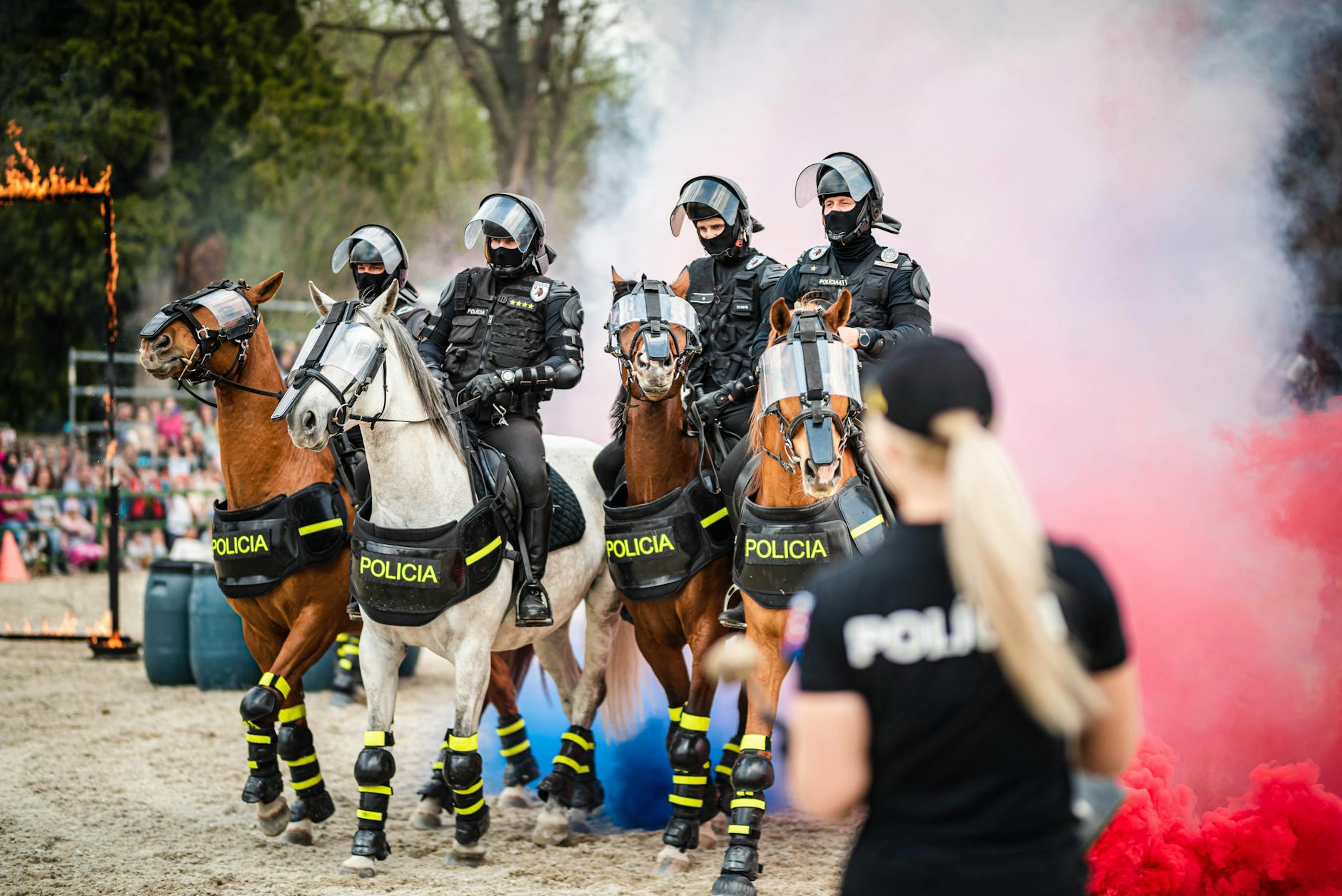
Business disruption appeared concentrated around march routes and assembly points, with transport hubs and central streets subject to temporary crowding, road closures and police barriers. For many Londoners, the visible effect of the day was the presence of officers, mounted units, barriers, helicopters or drones, and large groups moving through the capital under police supervision. Such operations are expensive, but police argue they are necessary to protect the right to protest while preventing violence.
By Saturday evening, authorities said the demonstrations had concluded or were dispersing, though officers remained on duty to manage the aftermath. The relatively low number of arrests compared with the scale of the crowds suggested that the separation strategy largely held, even as the arrests, officer injuries and alleged hate incidents showed the volatility of the day.
The political consequences may continue beyond the weekend. The government’s pre-emptive exclusion of foreign far-right figures is likely to be welcomed by groups concerned about extremism but criticised by free-speech campaigners and Robinson supporters as evidence of state overreach. The policing of the pro-Palestinian march will also remain under scrutiny from both supporters, who argue that Palestine activism is often unfairly restricted, and critics, who say authorities have not done enough to address antisemitic intimidation.
For the Metropolitan Police, Saturday was another major test of protest policing in a city where global conflicts and domestic grievances frequently become street-level events. The force must maintain neutrality while enforcing public order law, protect communities that fear targeted hostility, and avoid either under-policing disorder or over-policing lawful assembly. That balance has become increasingly difficult as protests are amplified by livestreams, social media narratives and political pressure from all sides.
The day ended without the large-scale violence that some officials had feared, but it left a clear picture of the pressures facing Britain: migration politics remain highly combustible, the Gaza war continues to mobilise large numbers of people, and central London remains the principal stage on which these disputes are publicly contested. The immediate operational story was one of separation, arrests and heavy policing. The wider political story is that Britain’s debates over identity, security and international responsibility are no longer confined to Parliament or broadcast studios; they are repeatedly filling the streets.
Leave a Reply