BELGRADE — Serbia’s ruling Serbian Progressive Party, or SNS, has formally moved to keep President Aleksandar Vucic at the centre of national power after his departure from the presidency, proposing that he become prime minister if the governing bloc wins an early parliamentary election expected this autumn.
The decision, announced as the party’s leadership gathered in the southern city of Nis on Saturday, September 5, provides the clearest political framework yet for Vucic’s next step. The Serbian president has repeatedly said that he intends to leave his current office before the scheduled conclusion of his second and final presidential term in 2027, but he has given no indication that he plans to withdraw from political life.
Instead, Vucic has increasingly presented a return to the premiership as the likely next stage of his career. Speaking on Serbian television ahead of the SNS meeting, he said that he was seriously preparing to lead the government if he received political and electoral backing. He also said he expected to call early parliamentary elections within days, identifying September 9 or September 10 as the latest likely point for formally starting the election process.
Possible election dates previously mentioned by Vucic include October 18 and October 25. Associated Press reported on Saturday that the early vote was expected on October 25, although the election timetable remains dependent on the formal constitutional steps required to dissolve parliament and call the ballot.
The SNS proposal is politically significant because Serbia’s constitutional system gives the government, headed by the prime minister, substantial executive authority. While parties frequently campaign around a declared prime-ministerial candidate, the eventual head of government is formally elected by the National Assembly after the parliamentary vote and the constitutionally prescribed process for forming a government.
A victory by the SNS-led political bloc therefore would not automatically install Vucic as prime minister. His return would depend on the parliamentary arithmetic after the election and on whether a majority of Serbia’s 250 lawmakers supports the proposed government. Nevertheless, the ruling party’s endorsement makes clear that Vucic is expected to serve as the central figure in its campaign.
Vucic has also begun describing how a future administration under his leadership would operate. He has said that, if chosen as prime minister, he would propose what he described as the smallest government in Serbia’s history, consisting of the prime minister and no more than 12 ministers. He has argued that Serbia needs a faster and more efficient government capable of responding to domestic and international challenges.
The planned change would return Vucic to an office he has held before. He served as Serbia’s prime minister from 2014 until 2017, when he moved to the presidency after winning the presidential election. Since then, he has remained the country’s dominant political figure, while successive prime ministers have formally headed the government.
His possible return to the premiership has been anticipated for months. In late June, Vucic announced that he would step down from the presidency and help his political movement compete in early elections. Analysts cited at the time by Reuters said that resignation from the presidency was unlikely to mean the end of his influence and could instead provide a route back to the government.
In August, SNS leader Milos Vucevic publicly said the party wanted Vucic to head its election list and become its candidate for prime minister. Vucevic said the issue would be decided by the party leadership, making the September meeting an important formal step in establishing the ruling movement’s election strategy.
The announcement comes at an exceptionally tense moment in Serbian politics. Demonstrations against the authorities have continued since the November 2024 collapse of a concrete canopy at the railway station in Novi Sad, which killed 16 people. The disaster became the catalyst for a much wider protest movement focused on allegations of corruption, failures of public accountability and the quality of state institutions.
University students have played a leading role in the demonstrations, organising marches, blockades and public gatherings across the country. Protesters have demanded accountability for the railway station disaster and broader institutional changes. The movement has created one of the most sustained challenges to Vucic and the SNS during their long period of political dominance.
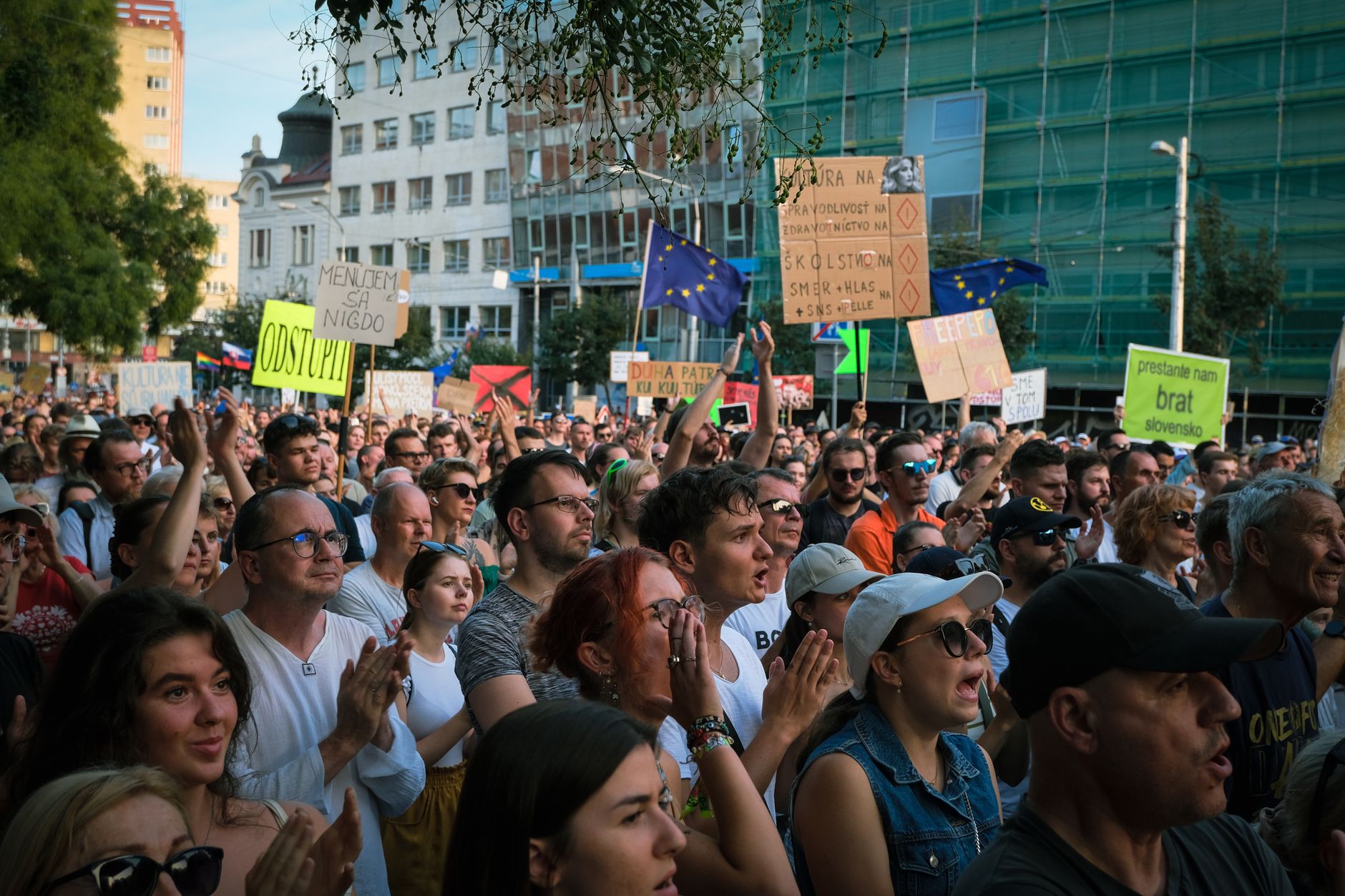
The government and Vucic have rejected accusations that they are responsible for systemic corruption and have repeatedly argued that state institutions are investigating wrongdoing. Vucic has also accused some protest organisers and political opponents of receiving foreign support or attempting to destabilise Serbia, claims that demonstrators reject.
The political confrontation was visible in Nis on Saturday. Students and other government opponents had called for a demonstration as the SNS Main Board assembled in the city. A significant police presence accompanied the gatherings, reflecting concern that the ruling party meeting and anti-government protests could bring opposing groups into close proximity.
Students in Nis had urged residents to gather before the SNS event to express opposition to Vucic and the governing party. In the days before the meeting, local media reported that some students had been contacted by police for informational interviews related to the planned protest. Vucic, for his part, said he would attend the Nis meeting despite opposition demonstrations.
The election campaign is therefore likely to be fought not only over competing economic and foreign-policy programmes but also over the legitimacy and performance of Serbia’s political institutions. The opposition and student movement have sought to turn public anger over the Novi Sad disaster into a broader challenge to the political system built during more than a decade of SNS rule.
Vucic and his allies are expected to emphasise economic development, infrastructure investment, employment, national sovereignty and political stability. During his years in power, Serbia has attracted substantial foreign investment, expanded transport infrastructure and maintained relationships with a wide range of international partners. Supporters credit the government with economic modernisation and stronger international visibility.
Critics, however, have accused the authorities of concentrating political power, weakening institutional checks and creating an uneven media environment. International organisations and European institutions have repeatedly raised concerns about rule-of-law reforms, media pluralism and democratic standards in Serbia, issues that have also affected the pace of its EU accession process.
Vucic’s transition from president to potential prime minister will consequently attract scrutiny over the distribution of executive authority. His opponents argue that political power has followed him personally through different offices. His supporters maintain that repeated electoral victories demonstrate public approval for his policies and leadership.
The immediate constitutional mechanics will matter. Vucic has indicated that he intends to dissolve parliament and leave the presidency as the country moves towards elections. Serbia would then have to manage both the parliamentary transition and the question of presidential succession, with another presidential election expected as part of the wider political reset.
The presidency itself carries important constitutional responsibilities, including nominating a candidate for prime minister after consultations with parliamentary representatives. The National Assembly ultimately elects the government by a majority of all deputies. That means any Vucic-led cabinet would still require sufficient legislative support after voters choose the next parliament.
The shape of the governing coalition could also change. The SNS has traditionally cooperated with the Socialist Party of Serbia, or SPS, in national government, but senior SNS officials have indicated that the parties may contest the forthcoming election separately. That could make post-election coalition negotiations more important if no single electoral list secures a majority.
Opponents of the SNS are themselves divided among established political parties, civic movements and an emerging student-backed electoral initiative. The protest movement has attracted university professors and other public figures, and its ability to convert street mobilisation into a coordinated electoral challenge will be one of the central questions of the campaign.
For Vucic, the election also represents a test of whether his personal popularity and the SNS electoral organisation can withstand the cumulative pressure generated by the protest movement. His political dominance has survived previous demonstrations, opposition boycotts and periods of international criticism, but the movement that followed the Novi Sad disaster has proved unusually persistent.
The election will also have implications beyond Serbia. The country is strategically important in the Western Balkans and is formally committed to joining the European Union. Brussels has repeatedly stressed that progress towards membership depends on reforms related to democracy, judicial independence, fundamental rights and alignment with EU foreign policy.
Serbia has maintained a complex geopolitical position. Belgrade condemns violations of territorial integrity in principle and has supported some United Nations resolutions concerning Ukraine, but it has not joined EU sanctions against Russia. At the same time, Serbia has developed deep economic and infrastructure ties with China while remaining heavily connected to EU markets and investment.
Vucic has defended this multi-directional policy as necessary to protect Serbia’s national interests. Critics in the EU and Serbian opposition argue that the approach has slowed foreign-policy alignment with Brussels and complicated the country’s membership prospects. Vucic said on September 4 that Serbia would remain on its European path, while expressing scepticism that the EU was prepared to admit the country.
Kosovo will remain another major issue for any future Serbian government. EU-mediated efforts to normalise relations between Belgrade and Pristina have produced agreements but recurring disputes over implementation. A government led again by Vucic would inherit responsibility for those negotiations at a time when the EU is seeking greater political stability across the Western Balkans.
Domestically, however, the immediate focus will be on the election timetable and the formal end of Vucic’s presidency. His announcement in June that he intended to resign represented a major political development because his current mandate was otherwise due to continue into 2027. Since then, his public statements have increasingly linked his departure to an early parliamentary vote and a possible return to government leadership.
The SNS decision in Nis reduces much of the remaining uncertainty over the party’s preferred scenario. Rather than seeking a successor who would become the ruling movement’s principal political figure, the party is preparing to campaign with Vucic positioned as its prospective prime minister.
That strategy will allow voters to treat the parliamentary election as a direct judgment on his continued leadership even though he will no longer be seeking another presidential term. It also ensures that the campaign will remain highly personalised around Vucic, as many Serbian elections have been during the SNS era.
For the opposition and protest movement, the challenge will be to persuade voters that changing Vucic’s office does not constitute the broader political change they have demanded. For the SNS, the objective will be to demonstrate that its electoral mandate remains intact despite months of demonstrations and criticism.
The next decisive step is expected within days, when Vucic has said he will formally call the election. Once the date is confirmed, Serbia will enter a compressed campaign in which control of parliament, the premiership and the wider direction of the country’s political system will all be at stake.
If the SNS-led bloc secures a parliamentary majority and Vucic receives the required support to form a government, Serbia could emerge from the election with the same dominant political leader exercising power from a different constitutional office. If the ruling party falls short, however, coalition negotiations and opposition coordination could produce a substantially more uncertain political landscape.
For now, the ruling party has made its preferred outcome explicit: after nearly a decade in the presidency, Aleksandar Vucic would return to the office of prime minister and continue leading Serbia from the head of government.
Leave a Reply